

Recovery & Sobriety
What to Do Instead of Drinking: Social Ideas That Don't Feel Like a Downgrade
-by
Kevin Beerman
May 12, 2026

Welp. It’s on your calendar now.
Maybe it was a yoga-and-mocktails thing a friend forwarded. Maybe it showed up in a Facebook group you joined at 2 a.m. three months ago and forgot about. Either way, you now have a sober event on your calendar, staring you in the face like a dentist appointment you scheduled six months ago in a moment of optimism. The rational part of you knows it’s probably fine. The other part is running worst-case scenarios on a loop.
That loop is worth naming. It sounds something like: What if I don’t know anyone? What if I’m awkward without a drink in my hand? What if everyone else seems totally fine and comfortable and I’m the only one who feels like I’m doing this wrong? The loop isn’t really about the event. It’s about going somewhere social without the thing you used to use to make social situations feel manageable. Alcohol can do a lot of jobs: conversation lubricant, something to do with your hands, permission to be awkward, a reason to stay, a reason to leave. Showing up somewhere without it doesn’t just feel different. It can feel like showing up naked. Like you’re the only one who didn’t get the dress code.
Here’s the thing nobody says out loud: the first sober event is less about the event and more about proving something to yourself. Not that you can have fun sober (you might not, the first time), but that you can show up. That’s the only bar worth clearing.
If you’ve been doing meetings (AA, SMART Recovery, whatever works for you), they serve a real purpose. They’re structured. They’re intentional. They carry a specific weight. That weight is the point. But it can also make “doing things sober” feel synonymous with “processing things sober,” and those are not the same activity.
A sober event isn’t a meeting in disguise. Nobody’s going to ask you to share. There’s no chip, no steps, no particular reason you have to identify yourself as anything. You’re just a person at a thing. The shared context, that most or all of the people there aren’t drinking, creates a kind of ambient ease that’s hard to explain until you’ve felt it. You’re not watching someone refill their glass and tracking your own want. You’re not mentally accounting for your choices. That cognitive overhead disappears, and what’s left is just the actual room.
That’s not nothing. That’s actually quite a lot.
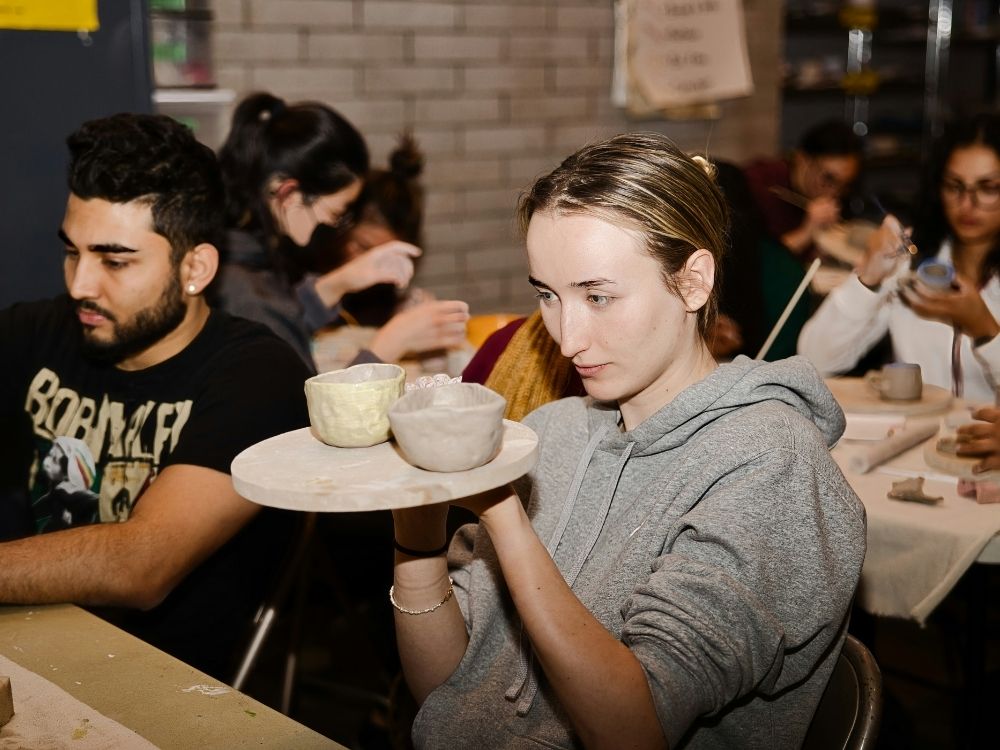
The sober event landscape looks nothing like it used to. It’s no longer just recovery-adjacent potlucks and awkward mixer situations, though those exist too. There are fitness events (run clubs, yoga, cycling, boxing), creative formats (painting, ceramics, cooking classes), dinners, comedy shows, music nights, hiking groups, travel experiences. Quality varies enormously. Some are genuinely great. Some feel like the organizer’s heart was in the right place but the execution was a little church-basement. That’s true of basically all events everywhere.
For your first one, the format matters more than you think. If unstructured socializing is where your anxiety lives, choose something with a built-in activity: a cooking class, a trivia night, a hike. The activity becomes the thing you’re doing. It gives you somewhere to put your attention and something to talk about that isn’t “so, are you sober too?” Structure is a gift when you’re new to this. Take it.
Also, shorter is better. A two-hour event is much easier to commit to than a four-hour open-ended gathering. Give yourself an out by design, not by anxiety. You can always stay longer.
This is the part that actually trips people up, and almost nobody talks about it specifically. You walk in. You don’t immediately see anyone you know. You’re standing in the entrance of a room that is already in progress, and every instinct you have is telling you to check your phone or find the bathroom or locate the exit.
Don’t. Keep moving.
The transition from outside to inside is the hardest part of the whole event. Your nervous system is doing a rapid threat assessment on a room full of strangers, and without alcohol to short-circuit that process, you feel every second of it. This is normal. It’s also temporary in a way that’s hard to believe when you’re in it, but it fades within a few minutes once you’ve picked a direction and started moving.
Have a plan for those first minutes before you arrive. Know where you’re going first: the drink station, the sign-in table, whoever’s running the event. Give yourself a first destination. It doesn’t matter what it is. Motion helps. Standing still in a doorway is where anxiety compounds; moving through a room, even aimlessly, is where it starts to dissolve.
If you see someone standing alone, go talk to them. They are almost certainly doing the same math you are. At a sober event especially, the person who looks like they’re waiting for permission to be there usually is, and so are you. That’s an easy conversation to start because you’re both already in it.
What to actually do when you get there
Here’s something nobody warned you about: your hands. They’ve always got to be doing something, fidgeting, reaching for something, wrapping around a glass. When you’ve spent years using a drink as a prop, suddenly losing that prop doesn’t just feel weird. It feels conspicuous. Get a non-alcoholic drink immediately, not because you need it, but because it gives your hands their thing to do and removes any social ambiguity about whether you’re drinking. Nobody is examining your glass. But you will feel better holding something.
Once your hands are sorted, your brain gets a little quieter. And that’s when the other stuff kicks in: you start noticing that you’re not sure what to say, or you’re scanning the room for cues about how everyone else is doing this, or you’re convinced you’re the only person who feels slightly out of place. You are not. The imposter feeling is almost universal at first. Most people at sober events remember their first one. Most of them felt exactly like you do right now.
The move, when all of that hits, is curiosity. Ask questions. People will talk for a long time if you’re genuinely curious, and genuine curiosity is one of those things that becomes easier when you’re not managing a buzz. You stop performing and start listening. The conversation stops being something you’re surviving and starts being something you’re actually in.
Here’s the truth, so it doesn’t catch you off guard: you might have a bad time. Not because something went wrong. Not because you did anything wrong. But because early sober social experiences can be genuinely harder than you’re expecting. The social anxiety that alcohol was quietly managing for years doesn’t disappear when you get sober. It shows up. Fully. Sometimes loudly. And at a social event, surrounded by strangers, it can feel like it’s skyrocketing. That’s not a sign that something is broken. That’s healing. Your nervous system is learning how to do this without a shortcut, and that process is uncomfortable before it’s anything else.
The good news is that you can work with what you can see. You couldn’t work with what alcohol was hiding. So while the discomfort is real, it’s also information; the kind you can actually use.
Now: it’s easy, when you’re trying to feel prepared, to rehearse all the ways it might be hard. It’s useful to do that. But it’s just as worth imagining it going well. Because it might. You might meet someone who makes you laugh, or get interested in something you didn’t expect to care about, or feel the specific relief of being somewhere that isn’t asking you to perform a version of yourself you’ve been quietly retiring. That happens too. More than you’d think, once you start showing up.
Either way, the research on this is pretty clear: spending time with people who share your values (including the value of not drinking) reinforces those values without requiring you to consciously defend them. You’re not fighting against the current. The room is moving in the same direction you are. Over time, that changes your sense of what’s normal. It changes your sense of who you are. Identity isn’t just something that happens internally; it’s built in rooms with other people.
You don’t have to stay until the end. You also don’t have to manufacture an excuse. “I have to be somewhere” is a sentence you’re allowed to say. So is “I’m going to head out, this was good.” Leaving early doesn’t mean the event failed. It might mean you maxed out your social capacity for the day, which is a thing that has a limit and deserves respect. Pushing past it in the name of proving something to yourself tends to create the kind of miserable evening that becomes the story you tell yourself about why you don’t do this.
If it went well, stay. The organic moment, where you stop thinking about being there and just are there, is worth waiting for when it’s available.
Sure, recovery is meetings, therapy, and reflection. But it’s also the long, boring middle: the stretches where you’re genuinely doing better but still not sure who you’re becoming, where the work is invisible and the progress is hard to point to. You’re building something in private, and for a long time, it stays there.
Sober events are where that private work meets the outside world. Where the version of yourself you’ve been constructing in quiet finally gets to walk into a room. That’s not incidental to recovery. It’s one of the more important parts of the whole thing, even though it looks, from the outside, like just going to a thing.
You already said yes. You’ve been doing the work. Now go find out who shows up.
Loneliness feeds addiction. Real connection interrupts it. More than 85 percent of NewForm members either quit or significantly reduce their substance use. That shift doesn't come from prescriptive lectures or shame. It comes from finding people who don’t just root for your growth—they grow alongside you.